
How to set up a home daycare contract families will sign
Last updated: 2026-10-21
Short answer: A daycare agreement says who, when, what you charge, when it is due and how care ends. Decide your policies first, fill in every blank, and have each family initial and sign before day one.
Money questions with families are easier when the answer is already written down. Is tuition due when the child is sick? What happens at 5:45 when pickup was 5:30? How much notice does a family give before leaving? A written parent-provider agreement answers those questions before anyone is upset, and it means every family is treated the same.
This guide explains what a home daycare or family child care agreement usually covers, how to fill one in, and what to send when a payment is late or care ends. It is general information, not legal advice: rules differ by state, province and territory, and a local lawyer can review your final version.
What the agreement covers
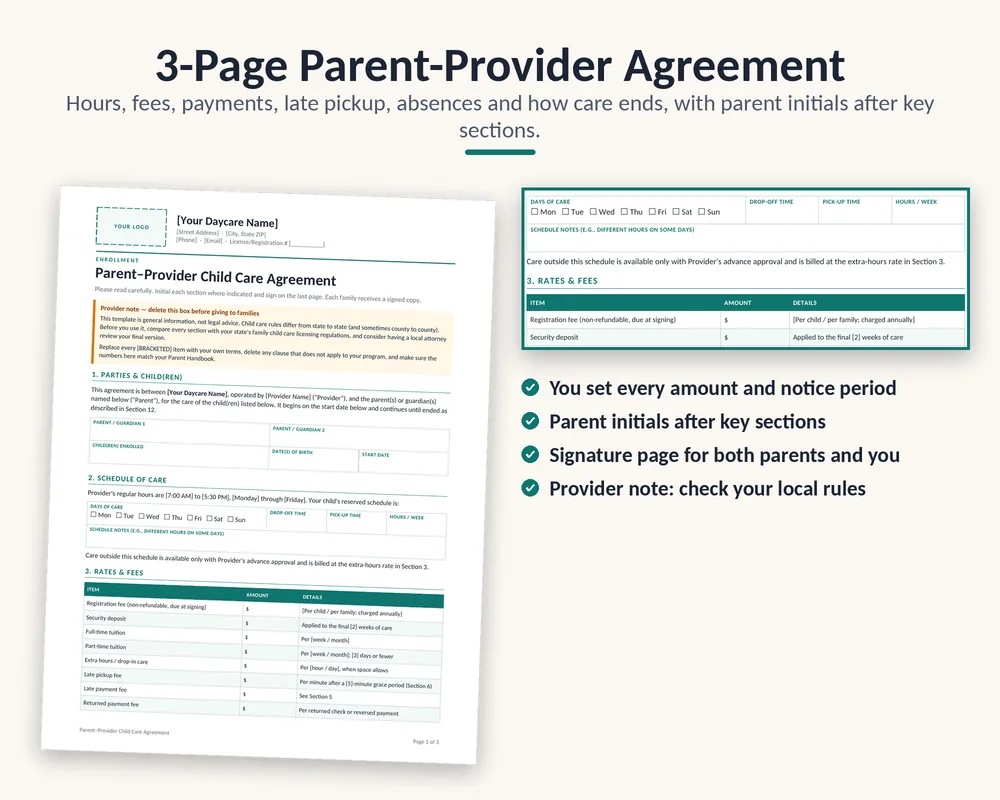
A good agreement is plain English and short enough that parents actually read it. Ours runs three pages in twelve sections:
- Parties and children: who the agreement is between, and the start date.
- Schedule of care: your hours and the child's reserved days and times.
- Rates and fees: registration, deposit, full-time and part-time rates, extra hours, late pickup, late payment and returned payment fees.
- Payment terms: when payment is due, how families can pay, and the receipts you give.
- Late payments: when a payment is late, the late fee, and when care may be suspended.
- Drop-off, pickup and late pickup: who may collect the child and the late pickup fee.
- Absences, vacations, holidays and closures: what is charged when the child is away or you are closed.
- What is included and what families provide: meals, diapers, spare clothes.
- Health, safety and emergencies: records families keep current and your consent to act in an emergency.
- Handbook and policy changes: how you give notice of a change.
- Trial period: the first weeks, when either side can end care on short notice.
- Ending the agreement: how much written notice each side gives, and what is owed.
Families initial the key sections and both parents sign at the end, and so do you.
How to fill it in, step by step
- Decide your policies first. Before you touch the document, write down your hours, rates, due dates, late fees and notice period. If you already have a parent handbook, use the same numbers; the two must agree.
- Fill in every blank. Times, notice periods and policies are [BRACKETED] blanks, and the fee table has empty $ boxes. Fill every one in. A bracket left in looks unfinished and leaves a gap a family can argue about.
- Delete what doesn't apply. No deposit? Take that row out. Don't charge for vacation? Change Section 7. It is your program; the agreement should describe it, not a generic one.
- Check the local rules. Compare each section with your licensing rules. In Canada, if your program takes part in a government fee-reduction program, it may set or limit your fees and deposits; the Canadian edition has a note about this.
- Remove the provider note. The shaded note at the top is for you. Delete it before you give the agreement to families.
- Sign before the first day. Go through the agreement with the family, have them initial and sign, sign it yourself, and give them a copy.
- Match the notices. The late payment and withdrawal and termination notices have their own blanks (notice periods, amounts, section numbers). Fill them in to match your final agreement.
When a payment is late
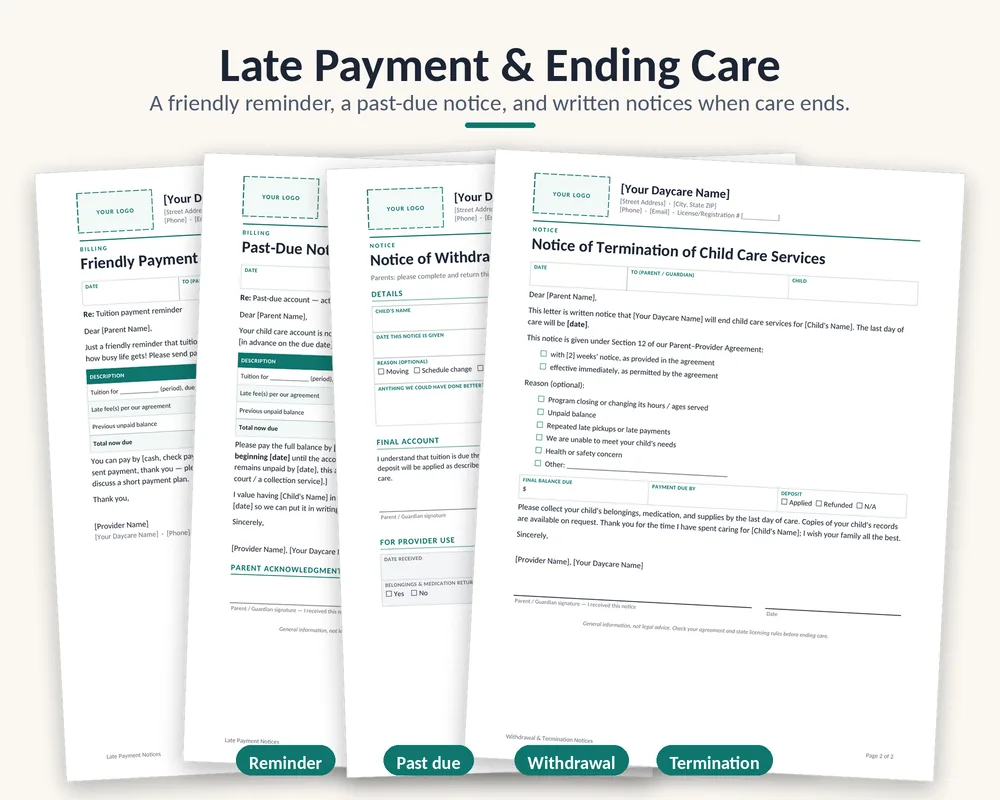
Start friendly. A short reminder that payment was due and hasn't arrived is often enough, since a payment can simply be forgotten. If the balance is still unpaid, a past-due notice sets out what is owed, quotes the late payment section of your agreement and gives a date. Both letters point back to the agreement, which is why the agreement has to say clearly what happens.
Keep a copy of every notice you send. Before you suspend care or pursue a balance, check your agreement and your local rules.
When care ends
A family leaving gives you a notice of withdrawal: the last day, a forwarding address, and an optional reason. A provider-use box records the final balance and the deposit. If you need to end care yourself, a written notice of termination says when the last day is, under which section of the agreement, and what is still owed. Calm, written and specific is kinder than a conversation at pickup.
Get the templates
The agreement, the two late payment notices and the withdrawal and termination notices, in US and Canadian editions, editable in Word or Google Docs, are in Daycare Contract (US and Canada) on Etsy.
Free tools for the receipts
The payment terms promise families receipts, and at tax time they ask for a statement of what they paid. Two free tools help: the year-end daycare tax statement generator for US families, and the child care receipt checklist for Canada, which lists what CRA says a receipt must show.
Want the ready-made version? The template in this guide is a digital download.
Get the template on EtsyRelated guides
General information only. It is not legal, tax or accounting advice; check the official source for your area or ask a professional.